
ACARS DRAMA LIVE

ACARS Drama

@acarsdrama

Want more?

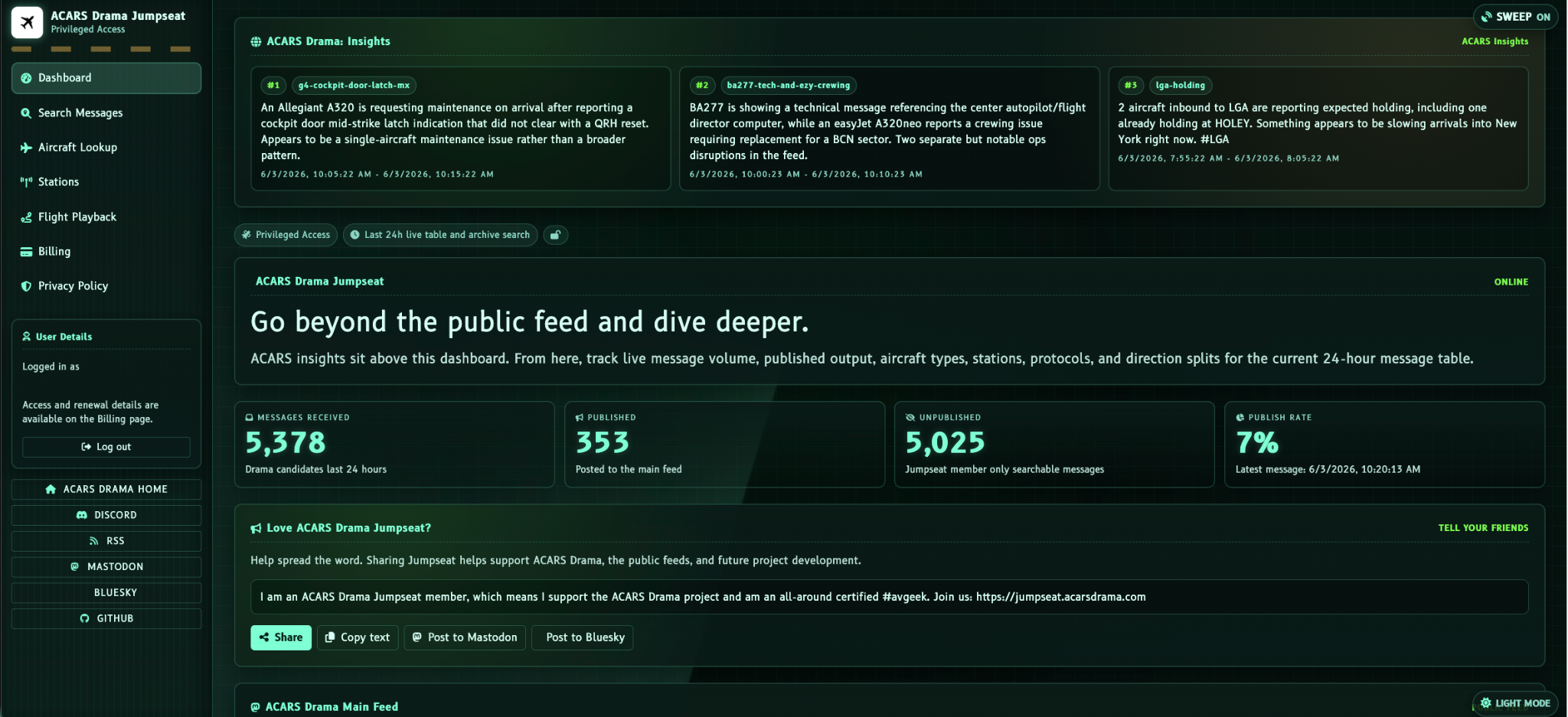
Become a Jumpseat member, support ACARS Drama, and unlock message search, station stats, aircraft lookup, archive sweeps, deeper ACARS insights, and REST API access.

Join Jumpseat
RECENTLY RECIEVED DRAMA (SLIGHTLY DELAYED FOR SAFETY) STATUS: DRAMA INGESTION ACTIVE

FEED BELOW

Welcome to ACARS Drama, a project dedicated to showcasing the behind the scenes, heroic efforts of commercial aviation

ACARS Drama is a project powered by a global network of aviation enthusiasts on the hunt for interesting cleartext ACARS and VDLM2 messages captured from passing aircraft using cheap radio hardware and free open source software.

All messages posted are stripped of identifying information and delayed by around five minutes.

(We should also probably mention most ACARS messages are very undramatic.)

A note on ACARS Privacy/Ethics

While ACARS messages have always been accessible to enthusiasts, there are a new generation of apps and services that share them, unfiltered, in real time. We are not one of them.

Our mission statement includes the rule that we set out to enjoy the perspective ACARS gives us on the hard work that happens behind the scenes in commercial aviation. Our intention in sharing these messages is not to embarrass or cause issues for anyone.

That’s why we redact PII, identifiers, and other sensitive details and have a slight safety delay, unlike some services.

In an ideal world, there would be no ACARS Drama, because ACARS would be transmitted encrypted over IP networks.

Our stance is one of, “just because you can, doesn’t mean you should”. We want to nerd out, sensibly, without causing problems.

ACARS Drama Jumpseat $7.99 / MONTH

The public feeds are free and will remain free. If you want to support ACARS Drama and nerd out even harder, Jumpseat membership is the best way to help keep the project running.

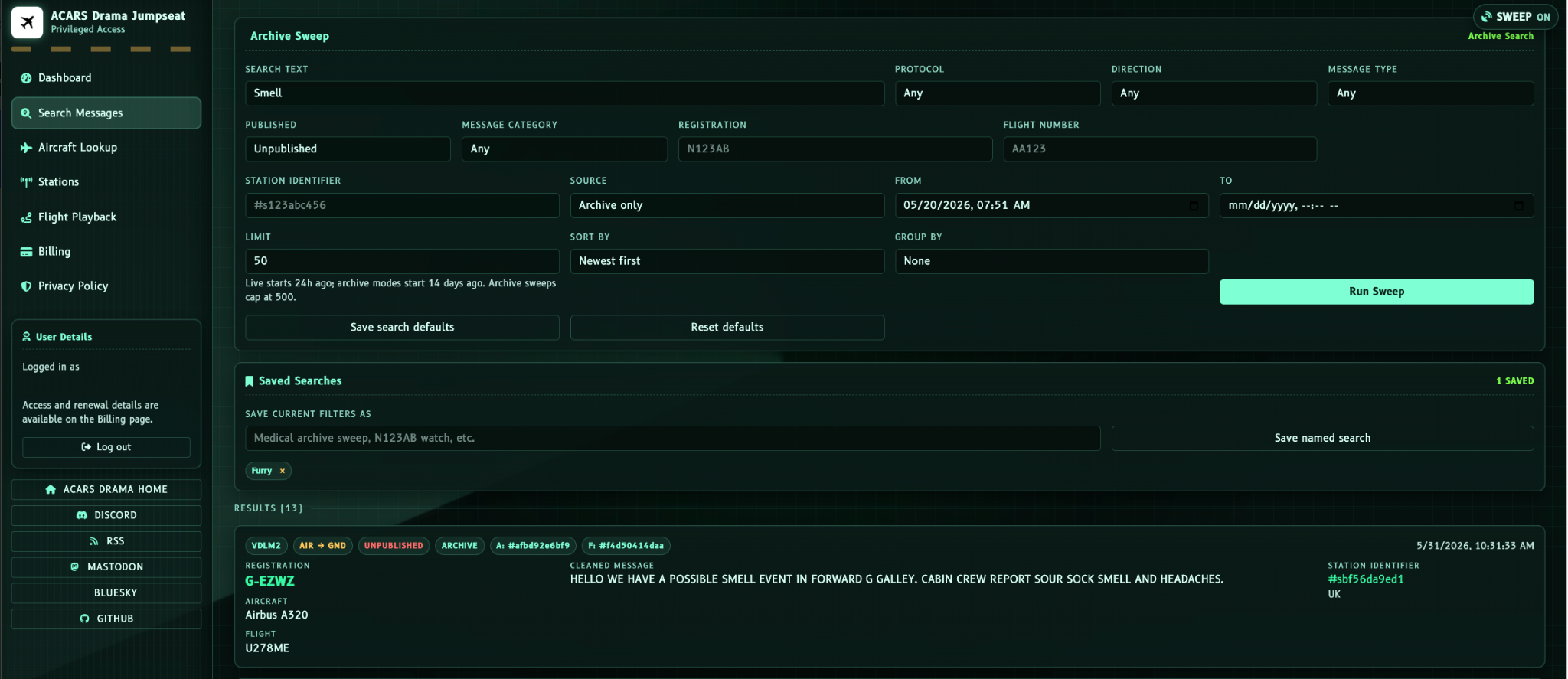
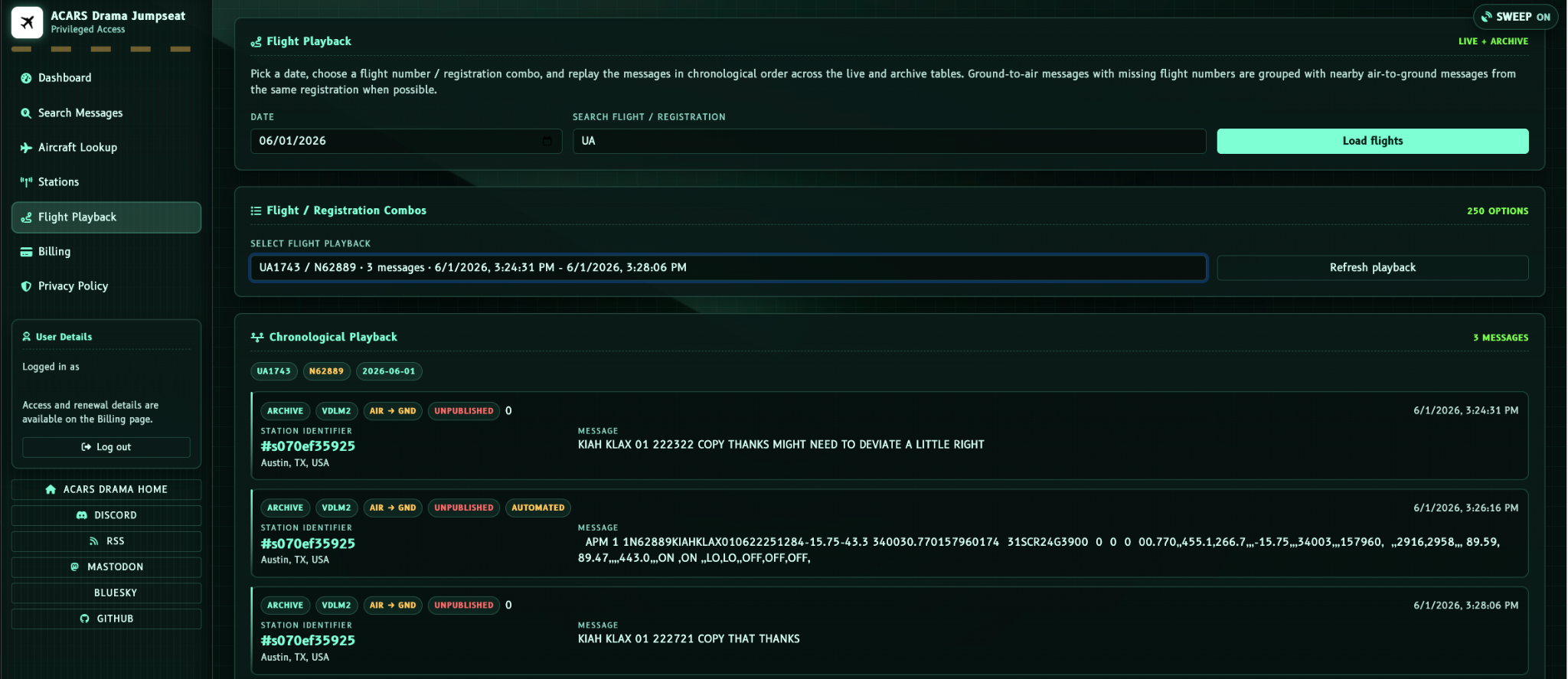
Jumpseat members can search recent and archived messages, look deeper into ACARS/VDLM2 activity, explore aircraft lookups, review station statistics, follow ACARS insights beyond what appears on the public social feeds, and use the REST API for personal dashboards, notebooks, and home-lab projects.

Message search Station stats Aircraft lookup ACARS insights REST API
Preview Jumpseat SWIPE / CLICK THROUGH

See what membership unlocks: dashboard metrics, archive search, flight playback, station reporting, and REST API access.

INFORMATION
What is ACARS Drama?

A project to map out every broken coffee maker in the sky

Aircraft Communications Addressing and Reporting System (ACARS) - an aviation radio system that is older than you, probably...

Plane flying over

Drama occurs onboard

Pilot reports drama via FMS keypad

Transmits unencrypted data over VHF

Signal captured by SDR

Operated by a sky drama farmer

Software decodes ACARS

Message parsed & cleaned

Posted to Drama engine

Message enters drama processing

Engine examines message

If drama found → post to feeds (after safety delay)

When an aircraft is flying overhead, various radio signals are being transmitted and received by said aircraft constantly. Some examples of the radio signals, of course, are voice communications between pilots and air traffic controllers, that most people are familiar with. These are, of course, critical for safety, and ensuring planes are at the right altitude, going in the right direction, and at the right speed.

In addition to voice, there are also a boat-load, well, plane-load I guess, of data signals. Amongst these data signals are the two types of signal that feed the bot’s insatiable thirst for drama. They are ACARS and VDLM2.

ACARS, which stands for Aircraft Communications Addressing and Reporting System, is a 1970’s era protocol that is still used today. A bunch of ground stations around the world are used to translate messages between computers in dispatch, maintenance and operations control rooms of the various airlines and their aircraft, and vice-versa, from the aircraft cockpit back to those airline computers.

VDLM2, which stands for VHF Data Link Mode 2, is similar in that it is a data transmission protocol that works over very high frequency (VHF) radio-waves, but it’s a bit more modern, uses different frequencies, is a bit faster, and can also carry ACARS messages.

So, in summary, ACARS is where the drama usually is, sometimes transmitted in raw ACARS form, other times it is encapsulated in VDLM2. Same result all round really, you just have to look in a slightly different place to decode the ACARS inside of VDLM2 messages.

There are lots of different open source software projects out there that work with software defined radios (SDR's) to capture ACARS transmissions. ACARS Drama takes the output from these various projects and formats them into posts you see on the bot's social feeds.

Below is an image of an FMC from a cockpit:
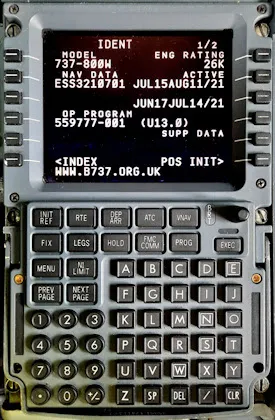
An FMC from a cockpit— source http://www.b737.org.uk/fmc.htm

Now, because of how the system works, it's much harder to capture the ground to air signals, unless you live in close proximity to an airport or ground station. So this means that pretty much 99% of what you see on ACARS Drama is air to ground. Essentially one side of a conversation, from the plane to folks on the ground. Sometimes it picks up ground to air, but it’s rare - it just depends on where the receiving SDR is based. If you do see a ground to air message, the bot will say “Ground to Air Message” instead of “Air to Ground Message”.

Because of the sheer volume of the messages ACARS Drama processes these days (thanks to our wonderful team of volunteers), around 250,000 an hour, most of which are just position and weather data, and automated readings from equipment, it would not be reasonable to post them all via the bot. That would just be annoying. So, we have carefully curated a list of keywords that the bot looks for in the messages received, to ensure that it only shares the ones with human-entered, “free-text” content. So when you see a message on the bot, it means that a pilot or crew member on the aircraft typed that into their ACARS terminal, which is usually a Flight Management Computer (FMC) device, like the one shown above.

As a message is typed and sent via ACARS, if that plane is in range of one of our volunteer sky drama farmers (people with SDR's all over the world) , then it’ll be processed by the bot's software and turned into the bot post that you see on Masto/Bluesky like this:

Example image showing ACARS message details

In this example, the message was captured in the Austin, TX area, and was sent from air to ground. If you see a thread of messages it means they were sent as part of the same exchange between air and ground, or ground and air. We strip out the flight number and registration as part of the anonymization process, for safety and privacy reasons.

It’s fair to say that the overwhelming majority of ACARS messages transmitted are extremely routine and boring, contrary to the name of the bot — which to be honest, is part of the joke. So, you’ll mostly see things about asking for gate confirmations, reporting “snags” with the aircraft, usually toilet or coffee maker related, but occasionally you’ll see reports of drunk passengers, fights onboard — you know, air travel things. That’s what makes it an interesting and fun project. You also get to see the pilots’ personalities shine through as well, which we love. We all have good days and bad days at work, so you might see the occasional snarky message — but ultimately, these are professionals doing a wonderful job in not always the easiest of circumstances.

So that’s what you’re seeing and how the bot works. You can follow along at https://live.acarsdrama.com/@acarsdrama if you aren’t already.

If you're interested in contributing data to the project - there is a bunch more information on this website that you can use to get started - we'd love to have you!

CONTRIBUTE
Harvest your sky drama!

If you’d like to contribute, it’s easy with an RTL-SDR, an antenna, some open-source software, and Internet access.

Quick Start
  • Send ACARS to feedthe.acarsdrama.com:5550
  • Send VDLM2 to feedthe.acarsdrama.com:5555

UDP or TCP (UDP preferred), JSON format. Use acars_router to split feeds if you already feed elsewhere.

Set a unique FEED ID (include your nearest airport ICAO). Email feeders [at] acarsdrama [dot] com to confirm reception.

Sky Drama Farmers get complimentary Jumpseat membership. Once your feed is running, email feeders [at] acarsdrama [dot] com to request access.

Need a bit more guidance?

Deep dive: acarsdec / dumpvdlm2 / acars_router
Sample docker: docker-compose.yml
ADSB.im Image + guide: ADSB.im step-by-step
Ask questions in the "ACARS Drama Club" Discord: Join here

RECOMMENDED SETUP
Recommended Equipment
  • RTL-SDR Blog V3/V4 — reliable, inexpensive SDR dongles for ACARS and VDLM2 reception.
  • NooElec NESDR Mini — compact SDR with strong performance for aviation band monitoring.
Tip: Use a VHF air-band antenna and mount it as high and clear as possible for best results.
Recommended Software
  • docker-acarshub — community-maintained ACARS/VDLM2 stack with built-in routing.
  • ADSB.im — preconfigured images for Raspberry Pi and other devices with ACARS Drama feeder support.
Combine with acars_router to feed multiple networks efficiently.
FILTERED TRAFFIC
A quick note about feeds

We understand the main ACARS Drama social feed is very busy (remember, we process 250,000 messages an hour, and the tiny fraction of those we post is still quite a lot). Therefore, we offer different ways for you to enjoy our project if you aren't interested in all the raw messages. See below for some more heavily filtered feeds, and also some RSS options.

Screen reader friendly version

We have created a mirrored, screen reader friendly version of the ACARS Drama feed on both Bluesky and Mastodon. These accounts are designed to make the feed easier to follow with assistive technology.

Mastodon Quieter Feeds
  • Main: @acarsdrama
  • Trending - reposts messages that get boosted/favorited a lot: @trending
  • Top Shelf - uses a stricter keyword set: @top_shelf
  • Emergencies & Failures - tracks broken things, system failures, and emergencies: @emergencies_failures
  • Medical - tracks medical events: @medical
  • Excreta - if it is launched from the human body, you'll find it here: @excreta
  • Bad Pax - often the worst part of flying is the people you are sat next to: @badpax
  • WTF - things that make you ask WTF?!: @wtf
  • Animals - our four-legged friends are not immune from drama: @animals
  • Weather - weather-related happenings and diversions: @wx
  • Ride Reports - bumpiness ratings: @ride_reports
  • Crewing & Ops - related to the operational side of aviation: @crewing_ops
RSS
ACARS GLOSSARY
Common terms you’ll see in messages

Tip: ACARS/VDLM2 messages are terse and very “ops”-y. This glossary decodes the most common shorthand.

People on the flight and on the ground
CA
Captain
CRO
Complaint Resolution Official — the person who handles disability-related complaints
CS
Customer Service
CSA
Customer Service Agent — the gate and check-in staff
DH
Deadhead — crew travelling as passengers to reposition for another flight
FA
Flight Attendant
FAM
Federal Air Marshal
FE
Flight Engineer — third crew seat on older types
FO
First Officer
GSC
Ground Security Coordinator — the person responsible for a flight's security procedures while it is on the ground
IRO
International Relief Officer — extra pilot carried on long flights so the operating crew can rest
JS
Jumpseat — the fold-down crew seats, or riding on one
LEO
Law Enforcement Officer — often requested to meet an aircraft at the gate
PF / PM
Pilot Flying / Pilot Monitoring — who is hand-flying vs. running radios and checklists
PIC / SIC
Pilot in Command / Second in Command
Purser / ISM
Lead flight attendant — In-flight Service Manager on some carriers
Ramp
The ground crew who load, push back, and marshal the aircraft
Redcoat
Gate supervisor
Dispatch, ops and control centres
CL
Cabin Log
DSPTCH
Dispatcher — shares legal responsibility for the flight with the captain
JL
Journey Log
LOGPAGE
The numbered entry in the aircraft technical log where a defect is recorded
MEDLINK / STAT-MD
Ground-based medical advisory services crews call for inflight medical events
MOC
Maintenance Operations Control — the engineering desk crews talk to about defects
MX / LM
Maintenance / Line Maintenance
OCC / SOC / NOC
Operations, System or Network Operations Control — the airline's nerve centre
Schedule, delays and turnarounds
ATA / ATD
Actual Time of Arrival / Departure
CTOT
Calculated Take-Off Time — the European equivalent of an EDCT
D0 / A14
On-time metrics — pushed at or before schedule / arrived within 14 minutes of schedule
EDCT
Estimated Departure Clearance Time — the slot a flight has been given
EFC
Expect Further Clearance — when to expect release from a hold
ETA / ETD
Estimated Time of Arrival / Departure
ETE
Estimated Time Enroute
Ferry
A flight with no passengers, usually repositioning or heading for maintenance
Gate hold
Held at the gate rather than burning fuel in a taxiway queue
GDP
Ground Delay Program — arrivals metered into a congested airport
GS
Ground Stop — departures to a destination halted entirely
MCT
Minimum Connect Time
MISCON
Misconnect — a passenger or bag that will not make the connection
OOOI
Out / Off / On / In — gate departure, wheels up, wheels down, gate arrival
RON
Remaining Overnight — aircraft or crew staying the night at an outstation
STA / STD
Scheduled Time of Arrival / Departure
Tech stop
An unscheduled stop for fuel or maintenance rather than passengers
Turn
The time between arriving and departing again on the next flight
Fuel, weights and loading
CG
Centre of Gravity
Final numbers
The last passenger, bag and cargo figures, needed before the loadsheet can close
FOB
Fuel on Board
LMC
Last Minute Change — a load change made after the loadsheet was produced
Loadsheet
The final document showing weights, distribution, and trim setting
MIN FUEL
An advisory that the aircraft can accept little or no further delay before fuel becomes an issue
Payload
Everything revenue-earning on board: passengers, bags, cargo, mail
ULD
Unit Load Device — the containers and pallets cargo travels in
W&B
Weight and Balance
ZFW / TOW / MLW
Zero Fuel Weight / Take-Off Weight / Maximum Landing Weight
Passengers and special handling
AVIH / PETC
Animal in the hold / Pet in the cabin
DEPA / DEPU
Deportee, accompanied / unaccompanied
HUM
Human remains being carried as cargo
INAD
Inadmissible passenger — refused entry and being returned
Level 1–4
Common severity scale for disruptive passenger behaviour, from verbal to life-threatening
MEDA
Medical case passenger
PAX
Passengers
PNR
Passenger Name Record — the booking reference and its contents
PRM
Passenger with Reduced Mobility
SSR
Special Service Request — the coded requests attached to a booking
UM / UMNR
Unaccompanied Minor
WCHR / WCHS / WCHC
Wheelchair needed to the ramp / to the aircraft steps / all the way to the seat
Aircraft systems and defects
AOG
Aircraft On Ground — grounded by a fault, the highest-urgency category
APU
Auxiliary Power Unit — the small turbine that supplies power and air on the ground
ATA chapter
The numbering system that files every aircraft system under a standard chapter
BITE
Built-In Test Equipment — a system's self-diagnostic output
CB
Circuit Breaker (in a weather message, Cumulonimbus instead)
CDL
Configuration Deviation List — the same idea for missing structural parts
CDU / FMC
Control Display Unit / Flight Management Computer — the keypad crews type ACARS messages on
DEFER
Carrying a defect forward under the MEL rather than fixing it now
ECAM
Electronic Centralized Aircraft Monitor (Airbus)
EFB
Electronic Flight Bag — the tablet that replaced the paperwork
EICAS
Engine Indication and Crew Alerting System (Boeing)
FDR / CVR
Flight Data Recorder / Cockpit Voice Recorder
FMS
Flight Management System
FOD
Foreign Object Debris — loose material that can damage an aircraft or engine
GPU
Ground Power Unit — the same job, from a cart on the ramp
GPWS / EGPWS
Ground Proximity Warning System, and its enhanced terrain-aware version
HYD
Hydraulics
IFE
In-Flight Entertainment
INOP
Inoperable / broken
IRS / ADIRU
Inertial Reference System / Air Data Inertial Reference Unit
LAV
Lavatory — the source of a remarkable share of all ACARS traffic
MEL
Minimum Equipment List — what may be unserviceable and still allow dispatch
N1 / EGT
Engine fan speed / Exhaust Gas Temperature — the numbers quoted when reporting an engine issue
NLG / MLG
Nose Landing Gear / Main Landing Gear
PACK
Air conditioning pack — supplies conditioned air to the cabin
PSU
Passenger Service Unit — the panel above the seats with lights, air and oxygen
QRH
Quick Reference Handbook — the checklist book for abnormal situations
SNAG
A defect or fault found on the aircraft
TCAS
Traffic Alert and Collision Avoidance System
Weather
CAT
Clear Air Turbulence — turbulence with no cloud to give it away
Chop
Rhythmic bumpiness, usually reported as light or moderate
CIG / VIS
Ceiling / Visibility
HOT
Holdover Time — how long de-icing fluid keeps working before another spray is needed
IFR / VFR
Instrument / Visual Flight Rules
IMC / VMC
Instrument / Visual Meteorological Conditions
LLWS
Low Level Wind Shear
METAR / TAF
Current weather observation / Forecast
PIREP
Pilot Inflight Weather Report
Ride report
A crew's description of how smooth or rough the air is at their level
RVR
Runway Visual Range
SIGMET / AIRMET
Warnings of significant weather — the first for severe, the second for less severe
TS / TCU
Thunderstorm / Towering Cumulus
Type I / Type IV
De-icing fluid, which removes contamination / anti-icing fluid, which prevents it
WX
Weather
XW
Crosswind
ATC, routing and navigation
7500 / 7600 / 7700
Squawk codes for unlawful interference / radio failure / general emergency
ALTN
Alternate — the airport a flight will divert to if it cannot land at the destination
ATC
Air Traffic Control
ATIS
Automatic Terminal Information Service — the recorded airport conditions broadcast
CPDLC
Controller–Pilot Data Link Communications — text clearances instead of voice
CTA / FIR
Control Area / Flight Information Region — airspace regions
DCT
Direct — cleared straight to a point, skipping the published route
DIV
Divert
ETOPS
Extended-range Twin-engine Operations — how far from a diversion airport a twin may fly
FL
Flight Level — altitude in hundreds of feet above the standard pressure datum
Go-around
Abandoning an approach and climbing away to try again
MAYDAY / PAN-PAN
Distress call / urgency call — the second is serious but not immediately life-threatening
NOTAM
Notice to Air Missions — a bulletin about anything temporarily changed, closed or unusable
Oceanic clearance
The clearance to enter oceanic airspace, with a level, speed and track
OTS / NAT track
Organized Track System — the daily North Atlantic route structure
PDC
Pre-Departure Clearance — the route clearance delivered by datalink before pushback
RRT / CDR
Reroute / Coded Departure Route — a pre-agreed alternative routing
RVSM
Reduced Vertical Separation Minima — 1,000ft spacing in the upper airspace
SID / STAR
Standard Instrument Departure / Standard Terminal Arrival Route
Squawk
The four-digit transponder code assigned by ATC
Step climb
Climbing to a higher level later in the flight as the aircraft burns off weight
TOC / TOD
Top of Climb / Top of Descent
Zulu / Z
UTC — aviation runs on it everywhere
Datalink and message plumbing
ACARS
Aircraft Communications Addressing and Reporting System
DSP
Datalink Service Provider — the networks, mainly ARINC and SITA, that carry the traffic
Freetext
A message typed by a human rather than generated by a system — the interesting kind
HF / VHF
High Frequency / Very High Frequency radio bands
HFDL
High Frequency Data Link — used out of VHF range, mostly oceanic and polar
Label
The two-character code at the start of an ACARS message saying what type it is
POS
Position report
SATCOM
Satellite communications, via Inmarsat or Iridium
SELCAL
Selective Calling — a tone code that lets ground stations ring a specific aircraft
Tail / Reg
The aircraft's registration, which ACARS Drama strips before posting
Uplink / Downlink
Ground to aircraft / aircraft to ground
VDL / VDLM2
VHF Data Link, Mode 2 — a faster, more modern carrier that can also carry ACARS
See a term we’re missing? Ping us on Mastodon or Discord and we’ll add it.
NOTAMS / RULES
Content Moderation + Legal Things

Since it's inception in the 1970's, ACARS messages have been readable to anyone nearby with an air-band radio attached to a computer. ACARS has long been treated as a public communications channel due to the lack of any encryption. ACARS messages have been publicly searchable in a variety of places on the internet for decades. Pilots are advised not to use ACARS for sensitive data transmission, and to instead use airline specific encrypted apps over IP networks.

All that said...we know that sometimes ACARS messages can contain personally identifiable information about passengers and the like (EVEN THOUGH THEY ARE TRANSMITTED COMPLETELY UNENCRYPTED). Our intention as enthusiasts is to enjoy the world of commercial aviation and nerd out - not expose or embarrass anyone, so the underlying code that posts these messages has checks to filter out things like names, medical details, and also PNR's (passenger number records) - you'll see the actual characters replaced by X's when this happens. The same is true for any security-related content that may have a safety impact. The last thing we want to do is cause any issues there. We also have a policy of delaying messages from being posted by five minutes and removing identification of the aircraft they came from.

Sometimes things slip through, and we remove the content very shortly after. Other times, they might not be noticed immediately. If you see something that you feel does not belong on ACARS Drama, please report it to us via our Mastodon instance, and we'll take a look.

Information shared on ACARS Drama is not to be used for flight planning or during the course of live flight operations.

ACARS Drama makes no claims or representation that the information shared on our platform is always completely accurate. The nature of the ACARS protocol is such that it is very possible to spoof messages declaring to be from a specific aircraft, when in fact it is not. We have built and are continually refining spoofed message detection, but this is the reality of protocols that do not include any sort of authentication or integrity checking mechanism.

ACARS Drama exists for every aviation fan to enjoy another perspective on the world of commercial aviation. We do not tolerate hate-speech, or any other discriminatory behavior on our platforms or tooling, and will remove anyone who doesn't treat others with respect.

SUPPORT
Support ACARS Drama with Jumpseat $7.99 / MONTH

ACARS Drama is free to follow, free to read, and the public feeds will remain free. Mastodon, Bluesky, RSS, Discord, filtered feeds, and feeder participation are still the heart of the project.

If you enjoy the project and want to help sustain it, becoming an ACARS Drama Jumpseat member is the best way to support us. Jumpseat membership helps offset the real costs of hosting, storage, bandwidth, processing, and infrastructure.

What began as a single Raspberry Pi hobby project has grown into a data firehose: a global volunteer feeder network processing roughly 250,000 messages per hour and enjoyed by thousands of aviation nerds around the world.

What Jumpseat unlocks
  • Search ACARS and VDLM2 messages beyond the public feed.
  • Explore recent traffic and archive sweeps.
  • Look up aircraft activity and message history.
  • Review station statistics, message volume, protocol mix, and published percentages.
  • Dig into ACARS insights and trends when you want to nerd out even harder.
  • Use the Jumpseat REST API for personal dashboards, notebooks, home-lab projects, and experiments.
Sky Drama Farmers

If you feed ACARS Drama, you are helping make the whole thing possible. Sky Drama Farmers receive complimentary Jumpseat membership.

Email feeders [at] acarsdrama [dot] com after your feed is running and we will get you set up.